Continue with Google

When I was a kid, my father brought his Queen out early in a game against me. I was shocked. "Father, why did you develop the Queen so early? I will attack it with Nc6!" He just smiled.
Hello Champions! GM Avetik here (or Avo, as my friends call me). Today I will show you an opening where White does exactly what my father did. It starts with 1.e4 e5 2.d4. Black takes the pawn with 2...exd4, and White brings the Queen out with 3.Qxd4.
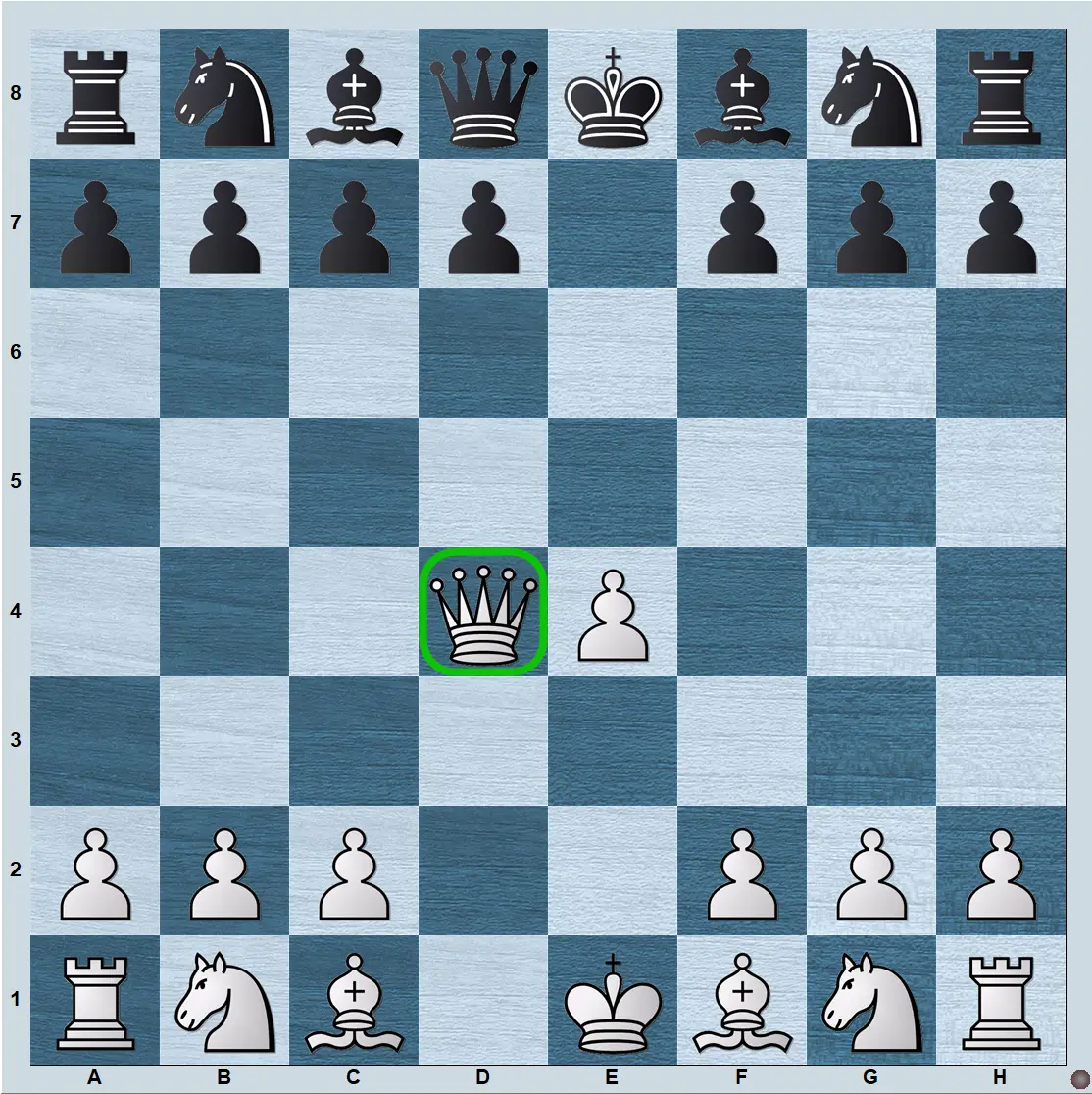
Center Game, position after 3.Qxd4
Why White Brings the Queen Out So Early
White wants two things from the opening: the center and fast development. The move 2.d4 challenges Black's e-pawn. After 2...exd4, White takes it back with the Queen and starts to move fast.
Then Black plays 3...Nc6. The Knight develops and attacks the Queen. So White must move the Queen again. Yes, that costs one move. "So White lost time for nothing?" Not at all. Look what White gets:
- The center is open, and Black's e-pawn is gone.
- The d-file is semi-open for the Queen and a Rook.
- The back rank clears fast, so White can castle queenside quickly.
- White has a clear plan from move three: Qe3, Nc3, Bd2, castle long, then push the h-pawn and attack on the kingside.
The Queen usually goes to 4.Qe3. From e3 it does two jobs. It stops a quick ...d5, and later it moves to g3 to attack the g7 pawn near Black's King.
Does this remind you of the Scandinavian Defense? It should. There Black brings the Queen out early. The Center Game is like a Scandinavian for White, with a pawn already traded in the center. Cool, isn't it?
An Ancient Opening That Came Back to Life
This opening has a long story. Skip ahead if you only want the moves.
Records point to 1590 or earlier. Philipp Stamma wrote about it in 1745. In the late 1800s, strong players kept finding new ideas for White. Siegbert Tarrasch, Mikhail Chigorin, and Wilfried Paulsen all played it.
Then players stopped using it. After 1900, White could not prove a real edge, so the top players moved on. Jacques Mieses, Sultan Khan, Savielly Tartakower, and Rudolf Spielmann were among the last to use it often.
But good ideas do not die. In the 1990s, Alexander Shabalov brought it back. After him, more grandmasters found new ideas and made Black work hard again.
Grandmasters who have played the Center Game include:
- Alexander Shabalov
- Alexei Shirov
- Michael Adams
- Judit Polgar
- Alexander Morozevich
- Ian Nepomniachtchi
- Arjun Erigaisi
The Main Line: 4.Qe3 (Paulsen's Attack)
This is the road you will travel most: 1.e4 e5 2.d4 exd4 3.Qxd4 Nc6 4.Qe3. The plan is short: Nc3, Bd2, then 0-0-0.
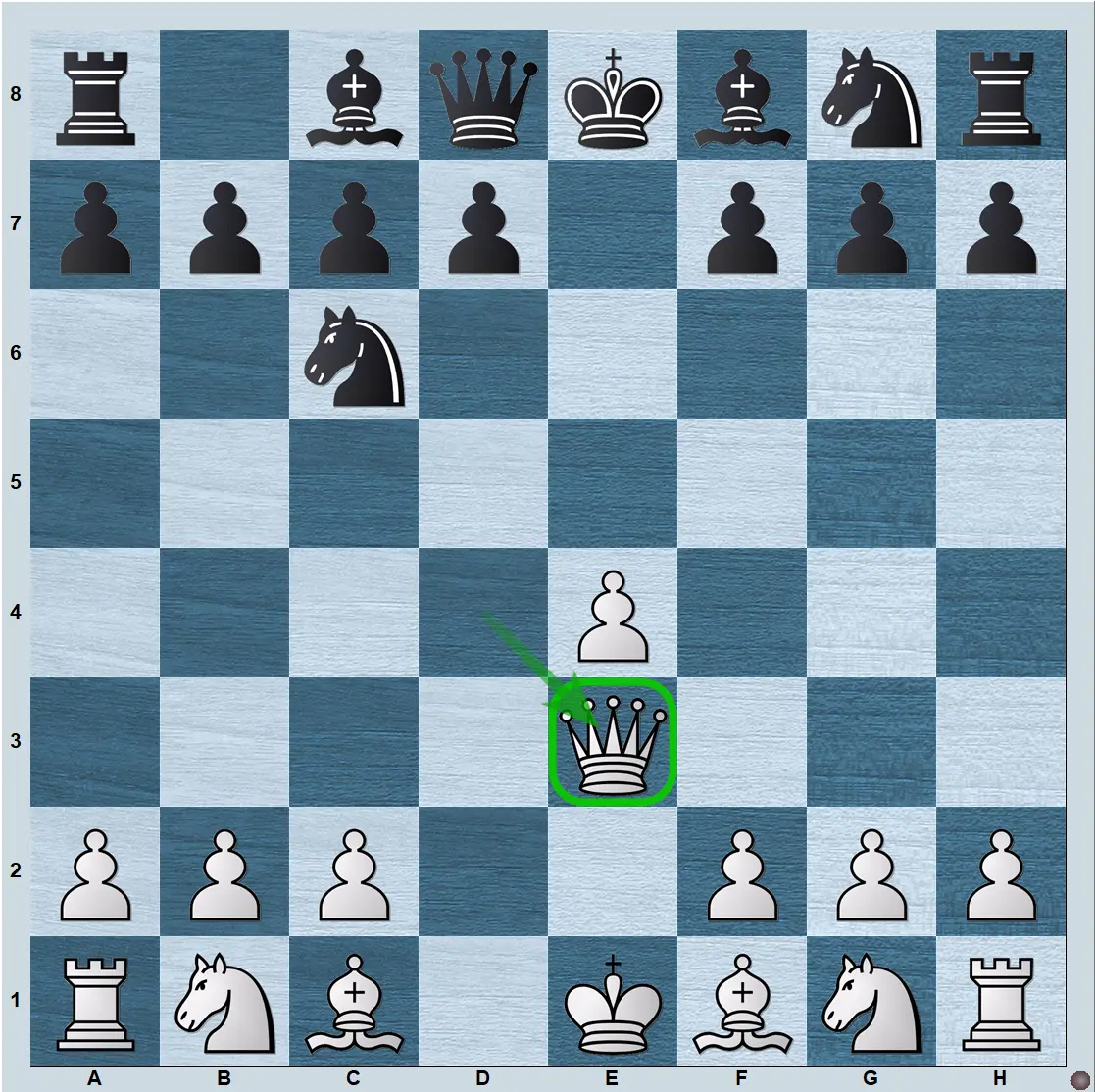
Paulsen's Attack, after 4.Qe3
The Main Position and White's Three Tries
A very common path is 4...Nf6 5.Nc3 Bb4 6.Bd2 0-0 7.0-0-0 Re8. Both Kings have castled on opposite wings. Now it is a race. White runs at Black's King on the kingside. Black runs at White's King on the queenside. The faster runner wins.
Here White picks one of three moves:
- 8.Qg3 is Tarrasch's idea. It offers the e4 pawn. After 8...Rxe4, White plays 9.a3, a move Shabalov made famous. White gets active play for the pawn.
- 8.Qf4 is Judit Polgar's choice. White plans f3 and g4, then brings the Queen back to g3.
- 8.Bc4 is the old move, first played by Szymon Winawer. Ian Nepomniachtchi liked it too. The play is complex but even.
If giving up the e4 pawn scares you, no worries. In these lines the open files and the fast attack are worth more than one pawn.
Black's Solid Setups
Black does not have to jump into the main position. A calm, strong try is 4...Nf6 5.Nc3 Be7. Black wants d5 soon to open the game. Two more good tries are 4...g6 and 4...Bb4+. Both score well for Black. So do not expect a free attack every game. A prepared opponent will defend well.
Other Queen Retreats: 4.Qa4, 4.Qc4, 4.Qd3
4.Qe3 is the main move. It is not the only one.
- 4.Qa4 looks like a Scandinavian line with the colors reversed. It has not scored well, so it is rare.
- 4.Qc4 and 4.Qd3 are newer. Few players know them, so you can surprise people.
The Attacking Plan: Castle Long and Storm the King
Here is your plan in almost every Center Game. Three steps.
Step 1. Develop fast. Play Nc3 and Bd2. Castle queenside with 0-0-0. Castling does two jobs at once: your King gets safe, and your Rook comes to d1, right on the semi-open file.
Step 2. Aim at the King. Bring the Queen to g3 with Qg3. From g3 it attacks g7, a key pawn in front of the castled King.
Step 3. Push the h-pawn. Your King is safe on the queenside, so your kingside pawns are free to run. The h-pawn goes forward, opens the way for your other Rook, and the attack on the kingside begins.
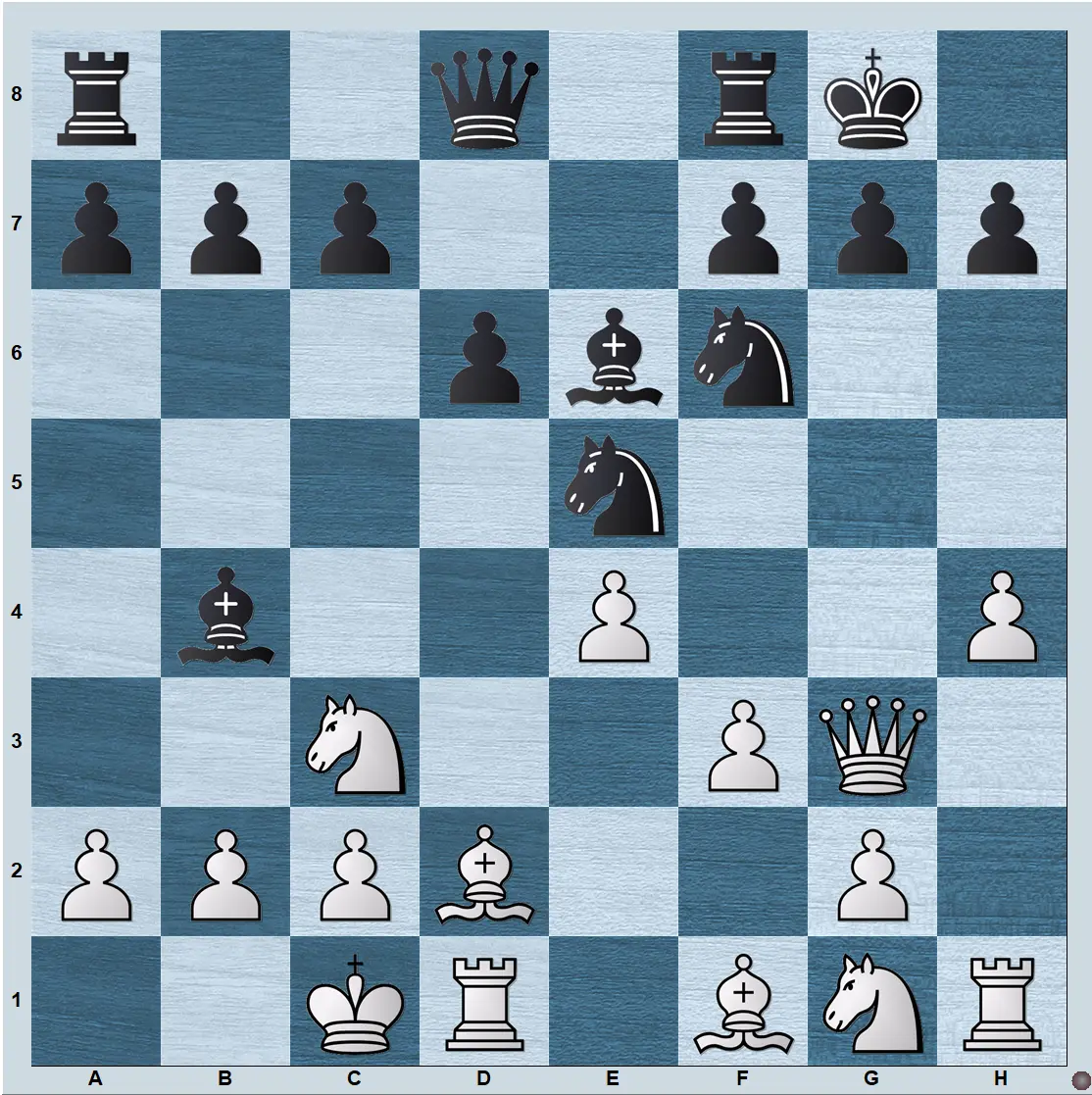
Opposite-side castling, White storms
Traps in the Center Game
The Center Game has some beautiful traps, where Black's most natural moves lead straight into trouble. Here are three to know.
Trap 1
Trap 2
Trap 3
White's Other Third Moves
White does not have to play 3.Qxd4. After 1.e4 e5 2.d4 exd4, there are other tries. Here are the ones to know.
Center Gambit: 3.Bc4
The move 3.Bc4 is an old idea, once called the Center Gambit. Instead of taking the pawn back, White develops the Bishop first and aims at the f7 square. The ideas are close to the main line. It is rare, so it has surprise value.
Halasz Gambit: 3.f4
The Halasz Gambit is 3.f4. It is rare and risky. The move dates back to at least 1840, and the Hungarian correspondence player Gyorgy Halasz played it a lot. Theory says it is not quite sound, but no one has shown a clear way to punish it. If you like sharp, unusual play, it is worth a try.
3.Nf3 and the Kieseritzky Variation
The quiet move 3.Nf3 usually turns into other openings, like the Scotch Game, the Petrov, or the Philidor. One move order has its own name: 3...c5 4.Bc4 b5, the Kieseritzky Variation. This is a different Kieseritzky from the famous one in the King's Gambit.
3.c3: The Danish Gambit
The move 3.c3 reaches the famous Danish Gambit. White offers the c-pawn, and often a second pawn on b2, for fast development and a strong pair of Bishops. It is a true gambit and a whole opening on its own, so we cover it in its own guide.
Read my complete Danish Gambit guide here.
Model Games
The best way to learn the Center Game is to watch it work.
Belyakov vs Zakhartsov, 2024
Paichadze vs Mchedlishvili, 2021
Nepomniachtchi vs Bok, 2024
Thank You
Thank you for spending your time with me, Champion. Your time is precious, and it means a lot that you gave some of it to this guide. Set the Center Game up on your board, play the main line a few times, and try it in blitz. Castle long, storm the King, and have fun.
With best wishes and love, For your growth and fun journey, GM Avetik (or Avo, as my friends call me) ❤️
Frequently Asked Questions
What is the Center Game in chess?
The Center Game is an opening for White. It starts 1.e4 e5 2.d4 exd4 3.Qxd4. Its code is C22. White takes the d-pawn back with the Queen and gets a semi-open d-file. The trademark is the early Queen move. After 3...Nc6 attacks the Queen, White retreats, almost always to 4.Qe3. From there White castles queenside and attacks.
Is the Center Game a good opening?
It is a good practical opening, but not a way to win by force. With careful play, Black equalizes. That is why top players mostly dropped it long ago. Still, it has real value. It is rare, so opponents are rarely ready for it. It leads to sharp, open play, and it is strong in faster time controls. Grandmasters such as Nepomniachtchi and Erigaisi have used it in serious games, which shows it is far from refuted.
Is the Center Game aggressive?
Yes. White usually castles queenside while Black castles kingside. With Kings on opposite wings, the game is a race. White brings the Queen to g3 to attack g7, uses the semi-open d-file, and pushes the h-pawn at Black's King. It is one of the sharpest ways to meet 1...e5.
What is the difference between the Center Game and the Danish Gambit?
Both start 1.e4 e5 2.d4 exd4. The difference is White's third move. In the Center Game, White plays 3.Qxd4 and takes the pawn back, with no sacrifice. In the Danish Gambit, White plays 3.c3 and offers the pawn, often a second one too, for fast development. So the Center Game is the solid road, and the Danish is the all-in gambit. They are cousins from the same starting position.
What is the main line of the Center Game?
The main line is 3.Qxd4 Nc6 4.Qe3, called Paulsen's Attack. White then plays Nc3, Bd2, and 0-0-0. A common position comes after 4...Nf6 5.Nc3 Bb4 6.Bd2 0-0 7.0-0-0 Re8, where White chooses among 8.Qg3, 8.Qf4, and 8.Bc4. All three lead to sharp play with Kings on opposite wings.
What is the Center Game Accepted?
"Center Game Accepted" is the name for the line where Black captures the pawn with 2...exd4. This is almost always Black's best move. From there White picks a third move. The main choice is 3.Qxd4, but White can also try 3.Bc4, 3.f4, or the Danish Gambit with 3.c3.
Why isn't the Center Game played at the top level?
It was mostly dropped after 1900. White could not show a real opening edge, and Black learned to equalize. So elite players moved on. The opening never went away, though. It comes back as a surprise weapon, and it has appeared in fast games and the odd elite event.
Is the Center Game good for beginners?
It can be. The plan is short and easy to repeat: retreat the Queen, castle queenside, then attack. That teaches useful skills like development, open files, and attacking the King. The catch is that Black's best lines reach an equal game, so treat it as a fun, practical weapon, not a free edge.
Related Openings
- Danish Gambit (1.e4 e5 2.d4 exd4 3.c3): the sacrificing sibling from the same move order. The most useful next stop.
- Goring Gambit (1.e4 e5 2.Nf3 Nc6 3.d4 exd4 4.c3): a Scotch-family cousin that reaches similar attacking play.
- Scotch Game (1.e4 e5 2.Nf3 Nc6 3.d4 exd4 4.Nxd4): the sound, mainstream way to play d4 against 1...e5, and our main repertoire choice here.
- Scotch Gambit (1.e4 e5 2.Nf3 Nc6 3.d4 exd4 4.Bc4): another sharp d4 try that aims at f7.
- Scandinavian Defense (1.e4 d5 2.exd5 Qxd5): the mirror idea, with Black bringing the Queen out early.
- Petrov's Defense and Philidor Defense: common places the 3.Nf3 move order can transpose into.