Continue with Google

Hello Champions! GM Avetik here (or Avo, as my friends call me).
Today we are going to have some fun. The Danish Gambit starts 1.e4 e5 2.d4 exd4 3.c3, and right away White does something that looks crazy. We give a pawn away, sometimes two, on purpose. In return we get fast development, open lines, and every piece pointing at the Black king.
This is the first gambit I give our beginner students, because it teaches the most important lesson in chess: piece activity. You give a little material, you feel how alive your pieces become, and you learn to attack. There is a smart, practical way to play it too, and that is exactly what I will show you here.
Let's go.
The Big Idea
Let me show you what White is really aiming for.
After 1.e4 e5 2.d4 exd4, White has given up the d-pawn. Why not just take it straight back? Because if we recapture with the queen, 3.Qxd4, Black plays 3...Nc6, attacks the queen, develops a piece with a tempo, and we lose time. That goes against the opening principles, and we do not want that.
So instead of grabbing the pawn back, we play a gambit. We play 3.c3.
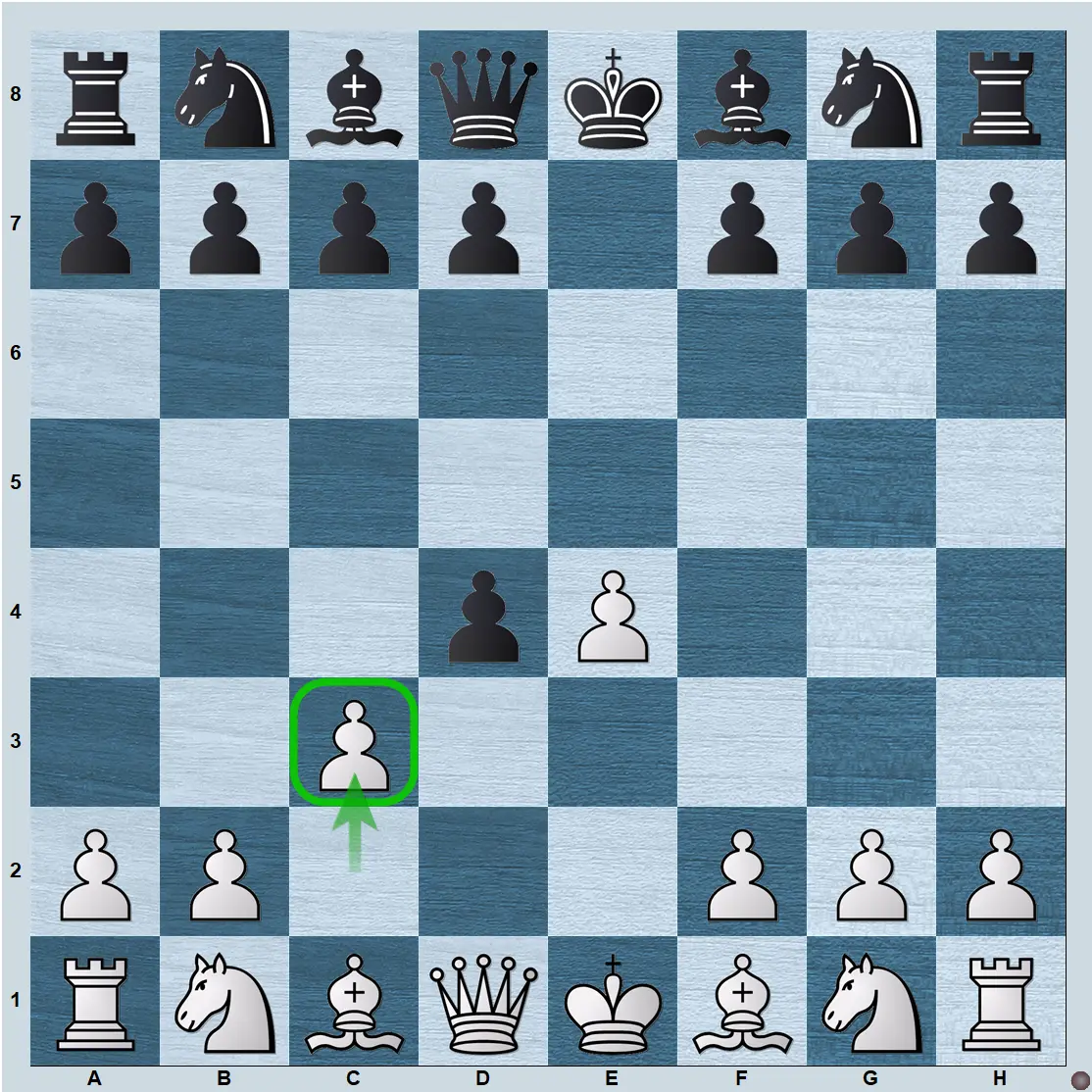
Danish Gambit, position after 3.c3
The idea stays the same whatever Black does: we trade a little material for speed and an attack. In the Danish, time matters more than material. Whoever uses their pieces better wins.
When Black accepts with 3...dxc3, White has two ways to play it. There is the famous, spectacular version, with two bishops aimed down the long diagonals, and there is a calmer, very practical version. I will show you both, in order: first the fireworks, then the one problem with them, and then the line I teach our students, and why.
Danish Gambit Accepted: The Two-Pawn Sacrifice
Let's start with the famous one, because it is beautiful.
After 3...dxc3, White plays 4.Bc4, offering a second pawn. If Black takes it with 4...cxb2 5.Bxb2, both bishops come alive.
Look at this picture. The bishop on c4 aims at f7, the weakest square in Black's camp. The bishop on b2 looks down the long diagonal at g7 and the king. Add Qb3 and you are hitting b7 and f7 at the same time. White is two pawns down, but the attack can be very fast and very dangerous.
Black has a few tries here:
- 5...Bb4+ is a check to slow White down. White answers with 6.Kf1 or 6.Nc3. Giving up castling looks scary, but the attack often makes up for it.
- 5...d6 is solid, and White continues 6.Qb3, pressing b7 and f7.
- 5...d5 is the important one. This is the move that changes everything, and it deserves its own section. Let's look at it now.
The Schlechter Defense
So here is the problem with the two-pawn line.
Instead of holding both pawns, Black plays 5...d5. Black gives a pawn straight back to open the position and finish developing. The point is simple and clever: by giving material back at the right moment, Black calms the whole attack down.
In the game Nyholm against Tartakower, Baden 1914, this exact method appeared, and Black came out fine. Most experts call the final position equal, and some even prefer Black because of the healthy queenside pawns.
This is the line that took the Danish off the top boards in the 1920s. Against the two-pawn sacrifice, 5...d5 is why strong players stopped fearing it.
Now, the good news for everyday chess: almost nobody finds 5...d5 over the board. At club level and in blitz, the two-pawn Danish keeps scoring wins. But I do not want you depending on your opponent not knowing a defense. So let me show you what I play instead and recommend our students.
The Line I Recommend: 4.Nxc3
Black has taken the pawn with 3...dxc3. Instead of going down the wild two-pawn road you just saw, I simply take the pawn back: 4.Nxc3.
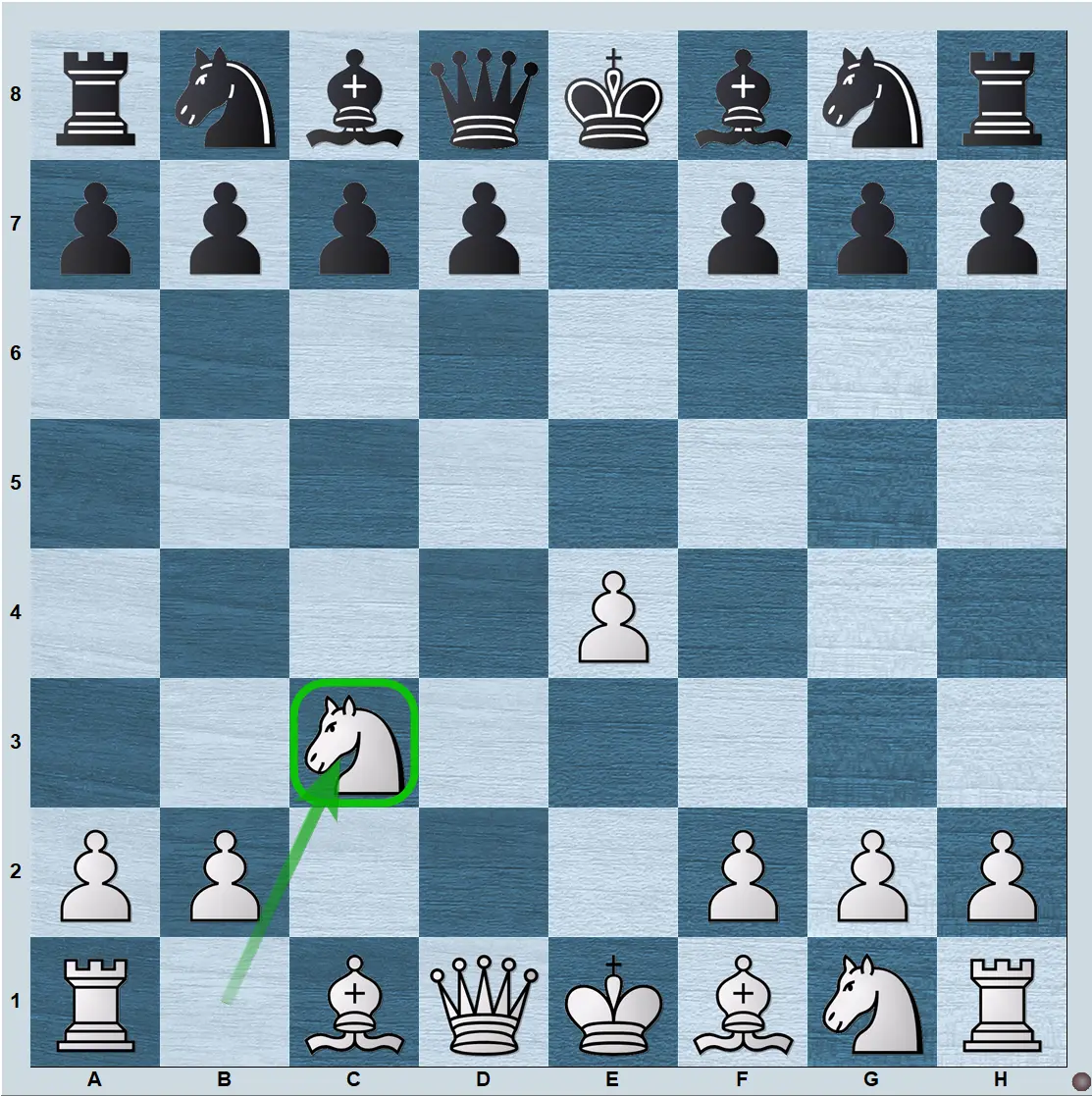
The Modern Danish, after 4.Nxc3
Look at what we have. A pawn in the center on e4 that Black does not have. A knight already developed on c3. Both bishops free to come out, and the queen ready to join. We are one pawn down, yes. But every piece is active, and that activity is worth a pawn. The bishop comes to c4 to stare at f7, the queen can swing to b3 to hit f7 too, we castle our king to safety, and our rooks come to the c and d files, where we have no pawns in the way. This was the move Alexander Alekhine himself liked.
So why do I teach this version to our students instead of the flashy two-pawn one? You already saw the answer.
The two-pawn line runs into the Schlechter Defense, and once Black knows 5...d5, the fireworks fall flat. The 4.Nxc3 line skips that whole argument. You keep your central pawn, you keep your activity, and you never give Black that easy way out. On top of that, it is simply easier to play. No sharp memorization, just good pieces on good squares, where the moves almost play themselves. That is perfect when you are learning.
Danish Gambit Declined
Not everyone takes the bait. A careful opponent can simply say no thank you.
After 3.c3, in case you face 3...d6, Black just plays a slow move and ignores the gambit. Easy for us. We take cxd4, get the center, and play a normal opening with extra space.
The other move worth knowing is 3...d5, sometimes called the Sorensen Defense, sometimes the Capablanca Defense. One of the best ways for Black to avoid the wild stuff. Black can also play 3...Qe7. It's a good move, but you won't see it often.
Brutal Traps
The Danish is a simple idea at heart, activity for a pawn, but it produces some of the prettiest knockouts in chess. The reason is always the same: in the two-pawn line, the bishops on the long diagonals plus a queen on b3 create mating patterns that show up again and again. If your opponent develops carelessly, the game can end very quickly.
Here are the patterns you should know.
A word of caution before you go trap-hunting. These traps work beautifully against an opponent who does not know the opening. A prepared player will not walk into them. So enjoy the traps, but lean on the 4.Nxc3 setup as your real, everyday weapon. That is what turns a trickster into a real Danish player.
Notable Games
Theory is the bones. Games are the muscle. Let me show you the Danish in action.
A Little History
Before we say goodbye, a short story. If you only wanted the moves, you already have them. But I think this one is worth a minute.
The gambit is usually credited to the Danish player Martin Severin From, who played it at the big Paris tournament of 1867. That is where the name "Danish" comes from in English.
But the trail is older than that. The Swede Hans Lindehn was playing 3.c3 regularly back in the 1850s. He even beat a young Wilhelm Steinitz, the man who would later become the first World Champion, with it in London in 1864. The story goes that From may have met Lindehn in Paris and picked up the idea there.
And here is a fun detail. This single opening has three names. In English we say the Danish Gambit. In German and Dutch it is the Nordic Gambit, and the writer Graham Burgess tells us that in Denmark itself they call it the Nordic Gambit too. You will also see it called the Norwegian Gambit. Same opening, same three moves, three different names depending on where you grew up.
The Danish had a golden age. Some of the greatest attacking players in history loved it: Alexander Alekhine, Frank Marshall, Joseph Blackburne, and Jacques Mieses all used it to create fireworks. These were players who wanted the initiative more than they wanted a pawn, and the Danish gave it to them. It faded from the top in the 1920s, once Black's defenses, above all the Schlechter idea, were worked out. But for the rest of us, it is as fun as ever.
Thank You
Champion, thank you for spending this time with me. I know your time is valuable, and you chose to spend some of it here. That means a lot.
Try the Danish in your next few games. Recapture with 4.Nxc3, keep your center, get your pieces active, and aim at the king. Some games will end in beautiful traps.
With best wishes and love, for your growth and fun journey,
GM Avetik (Avo)
Frequently Asked Questions
What is the Danish Gambit?
The Danish Gambit is an aggressive opening for White that starts 1.e4 e5 2.d4 exd4 3.c3. White sacrifices one or even two pawns to develop quickly and attack the Black king. It is also known as the Nordic Gambit and the Norwegian Gambit.
How do you play the Danish Gambit?
After 1.e4 e5 2.d4 exd4 3.c3, you offer the pawn. If Black takes with 3...dxc3, you choose how to recapture. The simplest and most practical way is 4.Nxc3, taking one pawn back, keeping your central e4 pawn, and developing fast with Bc4, Nf3, 0-0, and Qb3. The bolder way is 4.Bc4, offering a second pawn for the famous two-bishop attack. Beginners should start with 4.Nxc3.
Is the Danish Gambit good?
For club players and in blitz, yes, it is a very good practical weapon. The plans are simple, the traps are real, and most opponents have never studied the right defense. At the highest level it is not a serious try for an advantage, because Black can equalize with careful play. So it is excellent for fun and for fast games, less so for a World Championship.
Is the Danish Gambit sound?
The two-pawn version is not fully sound. Black equalizes with the Schlechter Defense, giving a pawn back with 5...d5 after 4.Bc4 cxb2 5.Bxb2. This is why the Danish left top chess in the 1920s. The calmer 4.Nxc3 line avoids that problem and is completely playable, especially below master level.
How do you defend against the Danish Gambit?
Do not be greedy. Against the two-pawn line, give a pawn back with 5...d5 (the Schlechter Defense), finish developing, and steer toward the endgame. You can also simply decline the gambit with 3...Qe7 or 3...d6 and play a normal, comfortable game.
Should Black accept the Danish Gambit?
Accepting is fine, but only if you know the 5...d5 idea. Black can take the pawns and then return one at the right moment to neutralize White's attack. If you do not know that idea, holding both extra pawns is dangerous. Declining with 3...Qe7 or 3...d6 is a safe alternative.
Is the Danish Gambit good for beginners?
Yes, it is one of the best first gambits to learn. It teaches you the value of fast development and the initiative, and it rewards active, attacking play. Start with the 4.Nxc3 version, and treat the opening as one weapon among many while you keep working on your development and tactics.
Why is it called the Danish Gambit, and what are its other names?
It is named after the Danish player Martin Severin From, who played it at the Paris 1867 tournament. The same opening is called the Nordic Gambit in German, Dutch, and in Denmark itself, and you will also see it called the Norwegian Gambit. They are all the same three moves: 1.e4 e5 2.d4 exd4 3.c3.
Related Openings
If you like the Danish Gambit, these openings share its ideas, structures, or attacking spirit. Each is worth a look.
- Center Game (1.e4 e5 2.d4 exd4 3.Qxd4): the parent opening, where White recaptures the pawn directly instead of playing 3.c3.
- Scotch Gambit (1.e4 e5 2.Nf3 Nc6 3.d4 exd4 4.Bc4): the same family of d4 pawn sacrifices, with the bishop coming to c4.
- Scotch Game (1.e4 e5 2.Nf3 Nc6 3.d4): the sound, mainstream cousin of all these d4 ideas, and a serious weapon for a lifetime.
- King's Gambit (1.e4 e5 2.f4): the other great romantic attacking gambit against 1...e5.
- Smith-Morra Gambit (1.e4 c5 2.d4 cxd4 3.c3): the same c3 pawn sacrifice idea, but against the Sicilian.
- Evans Gambit (1.e4 e5 2.Nf3 Nc6 3.Bc4 Bc5 4.b4): another romantic pawn sacrifice for fast development and a kingside attack.