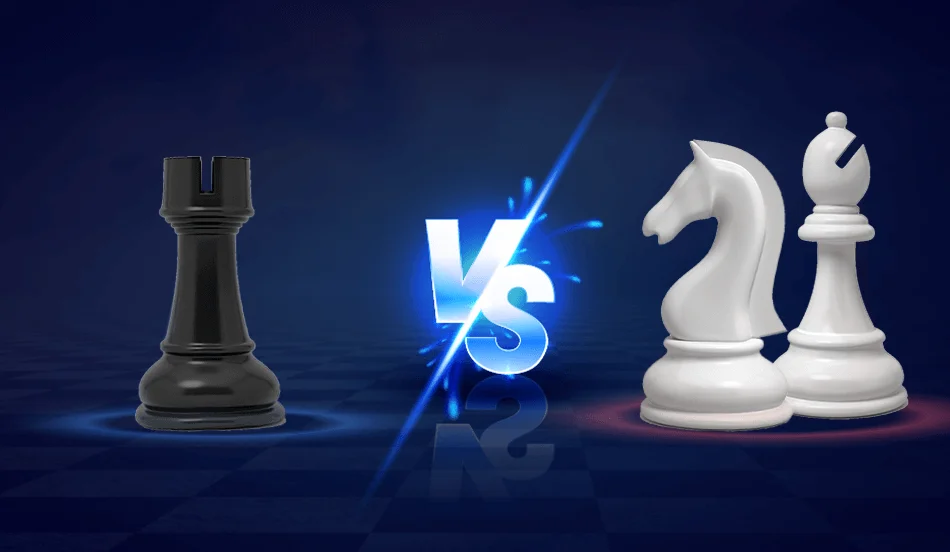
Chess players at different levels struggle to evaluate this material imbalance with Rook vs 2 minor pieces.
For beginners and intermediate players, one of the most common positions where this dilemma occurs is in a position like the one below.

It’s White to play. Is it worth giving up the 2 minor pieces in return for a Rook and a pawn after 1.Nxf7 Rxf7 2.Bxf7 Kxf7?
If you stack the material value of a Rook and pawn against that of a Bishop and Knight, it's roughly equal.
On the other hand, advanced and master-level players also face challenges here. One of my students, an IM, felt uncertain about such an imbalance. So he would avoid going into such positions. And as I started to cover this topic with more of my private students, the vast majority felt uncomfortable with it.
While preparing material for this topic, I found a few principles that can help make the right practical decision in Rook vs 2 Minor pieces position.
What are these principles? How do they help you decide which side is stronger in the battle of Rook and pawns vs 2 minor pieces?
This is what you’ll learn in this article. You’ll also see the different minor piece combinations and how they fare against the Rook.
Let’s start with the most common minor piece combination.
Rook vs Bishop and Knight
This is one of the most fighting material imbalances. Both sides have their trumps.
There was a former world champion who loved to play with the Rook in such situations – we’ll come to this later in the section.
First, let’s see how the two fare against each other in different situations.
Openings
Let’s return to the position in the introduction.

The sacrifice starting with 1.Nxf7 Rxf7 2.Bxf7 Kxf7 is dubious. The following game is a good example.
- Event
- Gaborone op
- Site
- Gaborone
- Date
- 2010.12.11
- Round
- 4
- White
- Gade, Nitish
- Black
- Machoko, Maxwell
- Result
- 0-1
- ECO
- C55
- 1. e4
- 1... e5
- 2. Nf3
- 2... Nc6
- 3. Bc4
- 3... Be7
- 4. Nc3
- 4... Nf6
- 5. O-O
- 5... O-O
- 6. d3
- 6... d6
- 7. Ng5
- 7... h6
- 8. Nxf7
- 8... Rxf7
- 9. Bxf7+
- 9... Kxf7
- 10. Re1
- 10... Nd4
- 11. Be3
- 11... c5
- 12. Nd5
- 12... Be6
- 13. Nxe7
- 13... Qxe7
- 14. c3
- 14... Nc6
- 15. a3
- 15... d5
- 16. b4
- 16... d4
- 17. Bd2
- 17... Rd8
- 18. bxc5
- 18... Qxc5
- 19. c4
- 19... a5
- 20. Qf3
- 20... Bg4
- 21. Qg3
- 21... Qd6
- 22. h3
- 22... Bd7
- 23. Qf3
- 23... Kg8
- 24. g4
- 24... Rf8
- 25. Qe2
- 25... Nh7
- 26. h4
- 26... Qg6
- 27. h5
- 27... Qf6
- 28. Rf1
- 28... Ng5
- 29. Bxg5
- 29... Qxg5
- 30. Rab1
- 30... Bxg4
- 31. Qe1
- 31... Bf3+
- 32. Kh2
- 32... Qg2#
0-1
As you saw in the game above, minor pieces could easily come into the game, whereas the Rook couldn’t perform to its fullest potential.
Rule: If you play with minor pieces, your goal is to maintain as many pieces as possible.
As a natural extension to this rule, the side with the minor pieces is better off with the queens on the board in the vast majority of cases.
In the openings, minor pieces are usually worth more than the Rooks. It’s easier for them to take part in the game.
Middlegames
While reading the excellent book ‘Learn from the Legends’ by Mihail Marin, I found something very interesting.
To my great surprise, I discovered Mikhail Tal was a big fan of playing with the Rook and pawn/pawns against minor pieces. Moreover, it was one of the signature methods of the Latvian Maestro.
The game below, played between Tal - Brinck Claussen perfectly illustrates how factors such as piece activity play a big role in such material imbalances.
- Event
- Havana ol (Men) fin-A
- Site
- Havana
- Date
- 1966.??.??
- Round
- 4
- White
- Tal, Mihail
- Black
- Brinck Claussen, Bjorn
- Result
- 1-0
- ECO
- D40
- 33. Nxd5!
Tal, committed to his style, chooses a spectacular and well-calcuated combination.
- 33. Qf5
with a big positional advantage after:
- 33... Qxf5
- 34. Nxf5
- 34... Kf8
- 35. Rb7+−
- 33. Qf5
- 33... Bxd5
- 34. Ra8!
obviously the point of White's combination.
- 34... Bxa2
- 34... Rxa8
- 35. Qxd5+
- 35... Qxd5
- 36. Bxd5+
- 36... Kf8
- 37. Bxa8
leads to a hopeless endgame for Black.
- 35. Rxd8+
- 35... Kf7
- 36. Qc6!
without this powerful move, White's combination would be pointless. Now Black is hopeless against White's attack.
- 36... Ne7
- 37. Qe8+
- 37... Ke6
- 38. Rc8!
- 38... Qd5
- 38... Bd5
Doesn't help.
- 39. Rc7
- 39... f5
- 40. Qd7+
[%csl Gd5,Ge7]
- 40... Kf7
- 41. Qxd5++−
- 38... Bd5
- 39. Rc3
threatening 40. Re3.
- 39... Qd7
- 40. Re3+
- 40... Kd6
- 41. Qb8+
- 41... Kc6
- 42. a4!?
an interesting solution.
- 42. Rc3+
- 42... Kd5
- 43. Qxb6+−
with a winning position for White.
- 42... Nd5
- 43. Re1
now 44. Rc1 is unstoppable.
- 43... Qd6
- 44. Rc1+
- 44... Kd7
- 45. Qc8+
Black resigned without waiting for 45..Ke7 46. Re1 Kf7 47. Qe8 mate
1-0
I’ll share another example with you on this before sharing an important rule.
- Event
- TCh-RUS Premier 2021
- Site
- Sochi RUS
- Date
- 2021.05.04
- Round
- 4
- White
- Rublevsky, Sergei
- Black
- Fedoseev, Vladimir
- Result
- 0-1
- ECO
- B25
In this position, Black has only one rook for White's two minor pieces. So the only question is whether White's able to solve the problem of his a4-Knight. In case of a positive solution, there's no reason why White shouldn't be simply winning.
- 30. Qe3?
- 30. Nc3!
It works tactically, with the cirtical line obviously being
- 30... Rxc3
- 30... Qc5
- 31. Qf6
- 31... Rf8
- 32. Rxb3
with an absolutely winning position.
- 31. bxc3
- 31... b2
the most important is not to stop the calculation here and check this position for White's ideas. It appears everything works great for White after...
- 32. Ra7!
- 32... Rb7
- 32... Qxa7
- 33. Qxa7
- 33... b1=Q
- 34. Qxf7+
- 34... Kh8
- 35. Qxg6+−
and White has too much material for being exchange down. Morevoer, the Black King is very vulnerable.
- 33. Rxb7
- 33... Qxb7
- 34. e5!
the key move.
- 34... dxe5
Black is lost now.
- 34... b1=Q
- 35. Bxb7
- 35... Qxb7
- 36. exd6+−
- 34... Qb8
- 35. Be4!
- 35... dxe5
- 36. Qb4+−
- 35. Bxb7
- 35... exd4
- 36. Be4
- 36... dxc3
- 37. Kg2
- 37... Kg7
- 38. Kf3
with an easy win.
- 30. Nc3!
- 30... Rc2
- 31. Ra1?
After this second mistake, White's not better anymore.
- 31. e5!
- 31... dxe5
- 32. Be4
would still maintain the advantage.
- 31... Qa5!
- 32. Qf4?
It was definitely not the best day for Sergei Rublevsky.
- 32. Qd4
White would still maintain the balance. For example:
- 32... Rd2
- 33. Qe3
- 33... Rxb2
- 34. Nxb2
- 34... Qxa1
- 35. Qc3$11
- 32. Qd4
- 32... Kg7
Black is already better.
- 33. Qxd6?
- 33. Qe3
- 33... Rc4
- 34. e5!
- 34... Rxa4
- 35. Rxa4
- 35... Qxa4
- 36. exd6
- 36... Qd7
Black still needs to show some technique.
- 33... Rd8−+
Now it's over. The rest is very simple.
- 34. Qa3
- 34... Rd3
- 35. Qe7
- 35... Rdd2
- 36. Nc3
Only now White can play Nc3, but it's obviously too late.
- 36... Qxa1
- 37. Qe5+
- 37... Kh7
- 38. Nd5
- 38... Rxd5
- 39. Qxd5
- 39... Rxf2
- 40. Qxb3
- 40... Qf1
0-1
Rule: In many cases, the material count might be misleading in evaluating the positions. It's more about piece activity, coordination, or how dangerous the pawn/pawns are.
Now have a look at the next position, between Gligoric - Psakhis, White made an interesting decision to capture on c5.
- Event
- Sarajevo
- Site
- Sarajevo
- Date
- 1986.??.??
- Round
- 5
- White
- Gligoric, Svetozar
- Black
- Psakhis, Lev
- Result
- 0-1
- ECO
- A75
Should White go for the position with two conncted central pawns and Rook for two minor pieces?
- 20. Nxc5
- 20. Nxb6
- 20... Rxb6
- 21. e5
- 21... dxe5
would lead to a pretty balanced position.
- 20... dxc5
- 21. Bxb8?
This appears to be a wrong move.
- 21. e5!!
choosing the position with piece down for one pawn, instead of having Rook and two central pawns for two minor pieces! White's two central pawns supported by the Bishop pair and White's heavy pieces are very dangerous, while Black's minor pieces lack coordination. One example line is:
- 21... Nd7
- 22. Bg2!
another difficult decision. Now 23.e6 is a big threat.
- 22. e6?
- 22... fxe6
- 23. Bxb8
- 23. dxe6
is refuted by a tactical trick
- 23... Ne5∓
[%csl Gf3]
- 23. dxe6
- 23... e5!
both the White Bishops are under attack and the game is very unclear.
- 22... Nd6
- 22... Qc7
- 23. e6
- 23... Nd6
- 24. exd7
- 24... Qxd7
- 25. Rxc5
- 25... Rxb2
- 26. Qd3
and White is better thanks to his strong d5-pawn.
- 23. e6
- 21. e5!!
- 21... Qxb8
- 22. Rxc5
- 22... Nd6
[%cal Gd6c4] Formally, White has a material advantage having two pawns and Rook for Black's two minor pieces (7 pawns vs 6 pawns if we calculate pawn value). However, in many cases, we need to evaluate dynamic factors. For example in this position, White's connected central pawns cannot advance, while Black's minor pieces are getting active very rapidly. In many cases, the simple pawn value might be misleading in evaluation of our specific imbalanced positions. It's more about piece activity and coordination, or how dangerous are the pawn/pawns.
- 23. Rec1?
After this natural move, Black is taking over and never looks back.
- 23. Qb4
although I would still prefer Black's position after
- 23... Nb5
- 23. Qb4
- 23... Nd7!
- 24. R5c2
- 24... Qb3?!
Inaccurate execution.
- 24... Re8
[%cal Gh5h4] with an advantage.
- 24... Re8
- 25. Bg2
- 25... Ne5
- 26. Rc3
- 26... Qb6
- 27. Qe2?
Missing another opportunity to come back into the game.
- 27. Qe3
- 27... Qb7
- 27... Qxb2
- 28. Rb3
- 28... Qa2
- 29. Ra3$11
- 28. Rb3
- 28... Qe7
- 29. h3
following up with 30.f4.
- 27... a5
- 27... Nb5!
- 28. Qe3
- 28... Qb8
was even stronger.
- 28. h3
- 28... h4
- 29. gxh4
- 29... Bh6!
White has three pawns and Rook against two minor pieces. However their position is objectively lost. All the three Black's minor pieces are very well coordinated, while White's passed pawns are all blocked and therefore fully neutralized.
- 30. Rd1
- 30... Bf4
- 31. Kh1
- 31... Kg7
- 32. h5
- 32... g5!
- 33. Rg1
- 33... Kh6
- 34. Bf3
- 34... Rb8
Great dark-squared strategy! Here I believe is the appropriate moment to mention rule number 5: The side with minor pieces is interested to keep as many pieces as possible.
- 35. h4
desperate attempt to muddy the waters.
- 35... gxh4
- 36. Qf1
- 36... Qxb2
- 37. Qg2
- 37... Bg3!
elegant tactics, which decides the game instantly.
- 38. fxg3
- 38... Qxc3
- 39. Bd1
- 39... Qe3
- 40. Qf1
- 40... Qxe4+
0-1
As you saw, White’s decision to capture the extra pawn on c5 turned out to be dubious despite them gaining an extra pawn in material terms. It also reveals another important rule.
Rule: The side with the minor pieces should strive to create outposts.
Position with weaknesses
Which side is at an advantage when there are many weaknesses? Think about it. I’ll reveal soon. Before that, have a look at the position below.
- Event
- Position with a weakness
- White
- Rook vs 2 minor pieces
- Result
- *
- 1... c5!
- 2. Rd1
- 2... cxd4
- 3. cxd4
- 3... Ne6−+
[%csl Gd4,Re6,Rf6]
A Rook can protect a weak spot once, while the minor pieces can attack twice, often giving the side with the minor pieces a big advantage.
Endgames
Exploiting the full potential of the Rooks during the opening and middlegame is hard because often, you don’t get many entry points.
But in endgames, the Rooks can play to their fullest potential.
And if they can infiltrate the enemy position and find targets to attack, they could become dangerous.
I’m going to show 2 examples from the game of Mikhail Tal that perfectly show this theme. The first one is between Tal - Tauve.
- Event
- Latvian Championship
- Date
- 1965.??.??
- White
- Tal, Mikhail
- Black
- Tauve
- Result
- 1-0
- 12. g4!
a winning idea. White pawn gets to f5 and Black's g7-pawn becomes a serious target.
- 12... Nfe7
- 13. f5+
- 13... Kf7
- 14. Rh1
- 14... Kg8
- 14... g6
- 15. g6!
now, Black is hopeless.
- 15... d4
- 16. Rh7
- 16... Nd5
- 17. g5
- 17... Nd8
- 18. Bd6
- 18... Nc6
- 19. Bf8!
The most elegant and the easiest solution.
- 19... Kxf8
- 20. Rh8+
- 20... Ke7
- 21. Rxa8
- 21... Kd6
- 22. f6
- 22... gxf6
- 23. g7
- 23... Nce7
- 24. Rxa6+
without waiting for 25. gxf6, Black resigned.
1-0
Notice how White’s Rook got into Black’s camp, giving Tal a winning advantage.
Rule: The side with a Rook and pawn/pawns should strive to trade the opponent’s rook to worsen the coordination of his pieces and be able to invade the opponent's camp.
The next game is played between two legends, Petrosian - Tal.
- Event
- URS-chT Cup 04th
- Site
- Moscow
- Date
- 1964.10.11
- Round
- 1
- White
- Petrosian, Tigran V
- Black
- Tal, Mihail
- Result
- 1/2-1/2
- ECO
- A13
Intertesting position: White has some pressure thanks to better coordinated pieces. Black has the opportunity to initiate imbalances, or to defend a somewhat inferior endgame. What would be your choice?
- 17... Nxe3!
It's very easy to guess what was the choice of Mikhail Tal. When I was showing this position to my students, many actually preferred not to play 17...Nxe3 but rather choose the solid Rfd8.
- 17... Rfd8
looks very solid. However, White retains a pleasant pull after the very surprising
- 18. h4!
with the following idea
- 18. Nc7
- 18... Rac8!
- 18... Nxc7
- 19. Bxb7
and White is significantly better thanks to his Bishop pair.
- 19. Nxd5
- 19... Bxd5!
- 20. Bxd5
- 20... exd5
[%cal Gf7f6,Gg8e6] and Black's plan is to play f6, following up by Kf7-e6 and it should be easily holdable.
- 18... a6
- 19. Nc7!
- 19... Rac8
- 20. Nxd5
- 20... Bxd5
- 21. Bxd5
- 21... exd5
- 22. h5⩲
now Black cannot play 22...f6 in view of 23.h6 breaking Black kingside pawn structure. Otherwise, Black's position is unpleasant.
- 17... Rfd8
- 18. Bxb7
- 18. fxe3?
- 18... Bxe3+
- 19. Kf1
- 19... Bxf3
- 20. gxf3
- 20... Bxc1
- 21. Rxc1
- 21... Rac8!∓
important move to eliminate White's initiaitve and offer a favourable Rook exchange. Rule: The side with a rook and pawn/pawns is interested to trade the opponent's Rook in order to worsen coordination (The Rook very nicely supports active minor pieces) of his pieces and of course, to be able to invade into the opponent's camp.
- 18... Nxd1
- 19. Rxd1
- 19... Rad8!
following our first rule, trading pair of rooks is definitely favourable for Black. Not only Black's second Rook gets active, but it's also ready to invade the second or first rank with a lot of damage.
- 19... Rab8?
in this case White is able to prevent rooks trade by means of
- 20. Be4
- 20... Rfd8
- 21. Bd3!
with advantage. Rule: If you play with minor pieces, your goal is to maintain as many pieces as possible. Futhermore, the Rook has very important role in enchancing the coordination of minor pieces.
- 19... Rab8?
- 20. Nc3
- 20. Rxd8?
would be a terrible mistake, since after
- 20... Rxd8
the Black Rook decisively invades to d2-square.
- 20. Rxd8?
- 20... Rxd1+
- 21. Nxd1
- 21... Rd8
- 22. Bf3
after a logical sequence of moves, we reached the position where Black has a choice
- 22... Rd2
the most natural continuation, although this time without decisive effect.
- 22... Bd4!?
Another rule: Playing with the Rook and pawn/pawns, we should be interested to trade opponent's Bishop pair. The other side should strive for maintaining their pair.
- 23. Ba3
- 23... Be5
threatening 24...Rd2
- 24. Bb4
- 24... a5
- 25. Be1
- 25... Rc8$11
[%cal Gc8c2] Black rook will penetrate along c-file , although White has enough resources to retain balanced position.
- 22... Bd4!?
- 23. Kf1
only move, otherwise White is clearly worse.
- 23... a5?!
Not the best choice for Black, since it makes his queenside pawns vulnerable.
- 23... Bxf2
the problem here is to see the following idea
- 24. Bc3
- 24... Rc2!
- 25. Be4
- 25... Rc1
- 26. Ke2
Black Rook will be trapped if not
- 26... Bh4!
and now 27.Kd2 is well met by 27...Bg5. I believe this position is easier to play for Black, but objectively it's equal.
- 23... f5
- 24. Be2
- 24... Bd4!
- 25. Bxd4
- 25... Rxd4
- 26. Ke1
- 26... Kf7
with an equal endgame.
- 23... Bxf2
- 24. Be2
- 24... e5?
only makes things worse for Black.
- 24... Bd4
- 25. Bxd4
- 25... Rxd4
- 26. a4!
is already problematic for Black due to the weakness of b6-pawn.
- 24... b5
with the following idea
- 25. a3
- 25... a4!
- 26. Bc3
- 26... Ra2
- 27. b4
- 27... Be7
- 28. Bxb5
- 28... Rxa3
- 29. Ke2
- 29... Bxb4!
- 30. Bb2
- 30... Ra2
- 31. Bc4
- 31... Rxb2+
- 32. Nxb2
- 32... a3
- 33. Nd3
- 33... Bd6
and it seems like Black has good drawish chances due to limited material.
- 25. a4!±
now White's advantage has crystallized: Black Rook is more or less neutralized. Meanwhile the b6-pawn is fixed and supposed to become a clear target in the long run.
- 25... Bd4
- 26. Bxd4?
In my opinion, White underestimated the recapture with the pawn on d4.
- 26. Bc1!
- 26... Ra2
- 26... Rc2
- 27. Be3
White is fine to trade dark-squared bishops, due to the fact that Black Bishop is an important defender of the b6-pawn.
- 27... Bxe3
- 28. Nxe3
- 28... Rc1+
- 29. Bd1±
- 27. Ke1!
- 27... f5
- 28. Bc4+
- 28... Kf8
- 29. Bd2
and in both lines, White's clearly better due to Black's vulnerable queenside pawn structure.
- 26... exd4!
certainly this is much better than Rd4.
- 26... Rxd4?
- 27. Ne3
and the wekaness of b6-pawn is a decisive factor. White should prevail easily.
- 27. Ke1
- 27... Ra2
Now the game is equal.
- 28. g4
- 28. Bd3
- 28... Kf8
- 29. Bb1
- 29... Ra3!
- 30. Bc2
- 30... d3
- 31. Bxd3
- 31... Rxb3$11
with equality.
- 28... Kf8
- 29. f4
- 29... Ke7
- 30. Nf2
- 30... Ra1+
- 31. Kd2
- 31... Ra2+
- 32. Ke1
- 32... Ra1+
- 33. Bd1
Petrosian decides to play on. Unfortunately for him, Tal was very accurate and didn't allow any chances for White.
- 33... Ra2
- 34. h4
- 34... f6
- 35. h5
- 35... Ke6
- 36. Nd3
- 36... g6
- 37. hxg6
- 37... hxg6
- 38. Be2
- 38... Rc2
- 39. Kd1
- 39... Rc3
- 40. Kd2
- 40... g5
- 41. fxg5
- 41... fxg5
- 42. Bd1
- 42... Kd5
- 43. Nb2
- 43... Rg3
- 44. Nc4
- 44... Kc5
- 45. Ne5
- 45... Kd5
- 46. Nf7
- 46... Rg2+
- 47. Kd3
- 47... Rg3+
- 48. Kd2
- 48... Rg2+
1/2-1/2
If you’re playing with the Rook, there’s another important strategy you can leverage.
- Event
- Chigorin Memorial 2018
- Date
- 2018.11.04
- Round
- 8
- White
- Saveliev, Alexei
- Black
- Mohite, Ranveer
- Result
- 0-1
- ECO
- C95
Power of the Rook.
- 63... Rxe4+!
In this endgame, Black decided to liquidate to a Rook vs Bishop + Knight endgame. And Black's advantage here is huge for 2 reasons: 1. They have an extra pawn on the Kingside that can become a passer. 2. White's minor pieces lack real targets. Practically, it's a very hard position to hold for White.
- 64. Kxe4
- 64... g5
- 65. Bf5
- 65. hxg5+
- 65... Kxg5
- 66. Ke3
- 66... Kh4
- 67. Be6
- 67... Kg3−+
- 65... gxh4
- 66. Nf4
- 66... Rg8
- 67. Ne2
- 67... Kg5
- 68. Nf4
- 68... Kh6
- 69. Ne2
- 69... Rg2
- 70. Kf3
- 70... Rh2
- 71. Bc8
- 71... Kg5
- 72. Be6
- 72... Rh1
[%cal Gh1b1,Gb1b3]
0-1
The Black Rook infiltrating the White’s position is decisive.
Rule: The side with rook and pawn/pawns should strive to create a passed pawn to force one of the opponent's minor pieces to deal with it.
This doesn’t mean the Rook is stronger than the Bishop and Knight in endgames. Everything depends on the specific position.
Here’s one example from a game between Nepomniachtchi - Aronian.
- Event
- Superbet Classic 2022
- Site
- Bucharest ROU
- Date
- 2022.05.13
- Round
- 8
- White
- Nepomniachtchi, Ian
- Black
- Aronian, Levon
- Result
- 1/2-1/2
- ECO
- C53
- 32. Kd3
Finally, White has fully consolidated his pieces. But the problem is that Black has accompished a lot and therefore should be able to hold this position easily.
- 32... h5
- 32... c6
- 33. Kc4
- 33... b5+!
otherwise White might play b5
- 34. Kc3
- 34... c5
- 35. Nxb5
- 35... cxb4+
- 36. Kxb4
- 36... Rd1
and Black will easily trade one pair of pawns, securing his position.
- 33. Kc4
- 33... c6??
I am not exactly sure why Black played this move, I would assume Levon forgot about b5-b6 advance. Instead
- 33... Re5
- 34. Bf4
- 34... Re4
- 35. Bxc7
- 35... hxg4
- 36. hxg4
- 36... Rxg4
should be an easy draw.
- 34. b5!
Of course!
- 34... hxg4
- 35. hxg4
- 35... Ke8
- 36. b6!
This is the point, now Black's b7-pawn is a clear target in long-run and White's position is winning.
- 36. bxc6
- 36... bxc6
- 37. Nxc6
- 37... Rd1
with an easy draw due to limited amount of material.
- 36... Kd7
- 37. Nb3
- 37... Rd1
- 38. Nc5+
The Knight is perfectly placed on c5.
- 38... Kc8
- 39. Bf4?
Ian missed a winning idea.
- 39. f4
switching to the Kingside. The threat is 39.f5 following it up with 40.Ne6.
- 39... g6
- 40. Bd4
- 40... f5
- 41. g5!
and there is no way Black can hold this position with two weaknesses on b7 and g6.
- 39. f4
- 39... Rg1!
- 40. Bg3
- 40... Rc1+
- 41. Kd4
- 41... Rd1+
- 42. Nd3
obviously White is playing for a win.
- 42... Ra1?
Now it's Black's turn to miss a drawish idea.
- 42... c5+
- 43. Kc4
- 43... Kd7!
activating Black king
- 44. Nxc5+
- 44... Kc6
- 45. Ne6
at first glance it looks lost, however Black escapes with study-like idea
- 45... Re1!
- 46. Nxg7
- 46... Re4+
- 47. Kb3
- 47... Rxg4
- 48. Nh5
- 48... Kxb6
- 49. Nxf6
- 49... Rd4
and it should be a draw.
- 43. Bd6
- 43. f3
- 43... Ra4+
- 44. Ke3
- 44... Ra5
- 45. Bd6!
was more convincing.
- 43... Ra6
- 44. Bf8
- 44... Ra4+
- 45. Bb4
- 45... Ra6
- 46. Kc5
- 46... Ra1
- 47. Kd4
White is going for the wrong idea
- 47. f3!
- 47... Kd7
- 48. Kd4
- 48... Rb1
- 49. Bc5+−
was the right winning plan.
- 47... Ra6
- 48. Bf8?
- 48... Ra4+
- 49. Nb4
- 49... Kd7!
it's always a good idea to activate the King.
- 50. f3
- 50. Ke3
would leave White with more chances.
- 50. Ke3
- 50... g6
- 50... g5!
Fixing the White pawn on f3 and thus preventing f3-f4 move would be way easier for Black. For example
- 51. Ke4
- 51... Ke6
- 52. Bc5
- 52... Kf7
and White has no constructive ideas.
- 50... g5!
- 51. Bc5
- 51. Ke3
- 51... Ra8
- 52. Bc5
- 52... Ke6
- 53. Kd4
- 53... Ra4!
- 54. f4
- 54... Ra1
Black's counterplay should be sufficient.
- 51... Ke6
- 51... g5
would make Black's life much easier.
- 51... g5
- 52. Kc4
- 52. f4
but I believe Black still holds after the accurate
- 52... Ra1
- 53. Nd3
- 53... Rg1
- 54. f5+!
- 54... gxf5
- 55. Nf4+
- 55... Kf7
- 56. gxf5
- 56... Rg8
- 52. f4
- 52... f5
- 52... g5
looks like an easy draw.
- 52... g5
- 53. g5
- 53... f4
- 54. Bd4
- 54... Kd6?
very strange mistake. After
- 54... Kf5
- 55. Bf6
- 55... Ke6
White cannot improve.
- 55. Bg7!
- 55... Kd7?
this is clearly losing.
- 55... Ke6
- 56. Bf6
- 56... Ra5
- 56... Kf5
loses control over d6-square, which can be exploited by
- 57. Kc5
- 57... Ra5+
- 58. Kd6+−
- 56... Kf5
- 57. Nd3
- 57... Ra4+
- 58. Kb3
- 58... Ra5
- 59. Nxf4+
- 59... Kf5
- 60. Ng2!
- 60... Ke6
and I suspect Black can still hold, although it's a tough defense.
- 56. Be5!
Once again, White reaches a winning position.
- 56... c5
- 57. Kxc5
- 57... Ra3
- 58. Nd5
- 58... Rxf3
- 59. Nxf4
- 59... Rf1
- 60. Kd5!
Very precise.
- 60... Rf3
- 61. Bc7
- 61... Rg3
- 62. Ne6
Now it looks like nothing can stop Ian and he is well on the way to prevail. But you can never relax against Levon, and this is exactly what happened in this game.
- 62... Rg1
- 63. Nc5+
- 63. Be5
would be more convincing.
- 63. Be5
- 63... Kc8
- 64. Ne4
- 64... Rd1+
- 65. Ke5
- 65... Re1
- 66. Kf4
- 66... Kd7
- 67. Nd6
- 67... Kc6
- 68. Nc4
- 68... Rf1+
- 69. Ke4
- 69... Re1+
- 70. Kd4
- 70... Kb5
- 71. Nd6+
- 71. Ne5
- 71... Rf1
- 72. Kd5
- 72... Rf5
- 73. Bd8!+−
is winning for White.
- 71... Kc6
- 72. Nf7
- 72... Kd7
- 73. Ne5+
- 73... Ke6
- 74. Nxg6
- 74... Kf5
- 75. Ne5??
At the end, Ian missed an amazing saving idea for Black.
- 75. Nh4+
- 75... Kg4
- 75... Kxg5?
- 76. Nf3++−
- 76. Ng2
- 76... Rd1+
or
- 76... Rg1
- 77. Nf4
- 77... Kf5
- 78. g6+−
- 77. Ke5
- 77... Kxg5
- 78. Ke6
and Black is hopeless against the White King heading towards the b7-pawn.
- 75... Rd1+
- 76. Kc5
- 76... Kxg5
- 77. Nf7+
- 77... Kf6
- 78. Nd6
I am pretty sure Ian was convinced that after grabbing the b7-pawn, Black is lost.
- 78... Rc1+
- 79. Kb5
- 79... Rb1+
- 80. Ka4
- 80... Ra1+
- 81. Kb3
- 81... Ke6
- 82. Nxb7
- 82... Rc1!!
and due to the threat of Rxc7 bxc7 Kd7, Black saves the game!
- 83. Kb4
- 83. Nd6
- 83... Rb1+
- 84. Kc4
- 84... Rxb6
doesn't help.
- 83. Bd8
- 83... Kd7$11
- 83... Rxc7
- 84. Nc5+
- 84... Kd6
- 85. bxc7
- 85... Kxc7
1/2-1/2
As you saw, Nepomniachtchi pressed for a long time with the 2 minor pieces. He had his chances, but Aronian’s brave defense helped him escape with a draw.
Rook vs 2 Bishops
2 Bishops are stronger than a Rook and a pawn in the majority of cases. Out of the different minor piece combinations, this pair is the most troublesome combination for the side with the Rook to play against.
Thanks to their long-range ability, the Bishops can control far-away corners of the board from a distance.
You might remember the following example from GM Gabuzyan’s article on the Bishop pair.

After 1.Kg5, White is completely winning!

The poor Rf6 is trapped, even though it can move to the maximum number of squares.
I’ll show you a practical position, from Vitiugov - Predke, and together we will draw useful conclusions from it.
- Event
- RUS-chT
- Site
- Sochi
- Date
- 2021.05.03
- Round
- 3
- White
- Vitiugov, Nikita
- Black
- Predke, Alexandr
- Result
- 1-0
- ECO
- E49
- 28. Nxc1
- 28... Nc8!?
heading to c4.
- 28... Nc6
- 29. Nb3
- 29... a5
In this case, after
- 30. Ke3
- 30... g5
it's White, who has to be careful.
- 29. Nb3
- 29... Nb6
- 30. Bc3!
White has to activate his dark-squared bishop, keeping it on c1 would be very depressing.
- 30... Nc4
Black is slighly better.
- 31. Bb4
- 31... Rc8?!
There was absolutely no reason for Black to allow White d-pawn to advance. Better idea would have been
- 31... f6
with idea to improve slowly by means of Kf7, g5 etc. In my opinion, White should be able to hold after
- 32. Bd3
- 32... Kf7
- 33. Be2
- 31... f6
- 32. d5!
of course!
- 32... Rd8
- 33. Na5
A nice tactical resource.
- 33... Nxa5?
this is already losing mistake.
- 33... exd5
- 34. Nc6
- 34... Rd7
- 35. exd5
- 35... g6
would hold for Black.
- 34. Bxa5
- 34... Rd7
- 35. Ba2!
- 35... exd5
- 36. exd5
Now the White passer easily decides the game.
- 36... Kf8
- 37. d6
- 37. Ke3!?
- 37... Ke8
doesn't help.
- 37... Rxd6
- 38. Bb4
- 38... Ke7
- 39. Bxd6+
- 39... Kxd6
- 40. Bxf7+−
and White wins.
- 38. Bc7
- 38... a5
- 39. Kf3
- 39... Rxc7
- 40. dxc7
- 40... Kd7
- 41. Bxf7
- 41... Kxc7
- 42. Kg4
- 42... Kd6
- 43. Kxh4
1-0
Rule: While playing with rook and pawn/pawns, you should be interested to trade the opponent's bishop pair, the other side should strive to maintain their bishop pair.
Rook vs 2 Knights
Among the different minor piece combinations, 2 Knights fare the worst against the Rook and pawn. It’s simply harder for them to coordinate. Here's a game played between Kramnik - Short.
- Event
- Olympiad-38
- Site
- Dresden
- Date
- 2008.11.19
- Round
- 6
- White
- Kramnik, Vladimir
- Black
- Short, Nigel D
- Result
- 1-0
- ECO
- D07
- 19... N6e7
- 20. Bxb5!
In the endgame, a Rook and two pawns are usually stronger than two Knights.
- 20... axb5
- 21. Nxb5
- 21... Rda6
- 21... Rb7
- 22. Nxd6
- 22... Nxd6
- 23. Rc5
- 22. Nxa7
- 22... Rxa7
- 23. Rc5
- 23... Nb6
- 23... Rxa3
- 24. Rxc7
[%csl Gb4]
- 24. Ra1
- 24... Kf8
- 25. a4!
- 25... Ke8
- 26. a5
- 26... Nc4
- 27. Ra2
- 27... f5
- 28. Kf1
- 28... Kd7
- 29. Ke2
- 29... Nd6?
This allows the White pawns to move forward.
- 29... c6
- 30. Kd3
- 30... Nd6
- 31. f3⩲
- 30. b5!
- 30... Nc4
- 30... Nb7
- 31. Rxc7+!
- 31... Kxc7
- 32. b6+
- 32... Kb8
- 33. bxa7+
- 33... Kxa7
- 34. Rc2+−
- 31. Ra4!?
- 31... Kd8
- 31... Rxa5?
- 32. Rcxc4
- 31... Nxa5?
- 32. Rc2
[%cal Rc2a2]
- 32. a6
- 32... Nb6
- 33. Ra1
- 33... Nec8
- 34. h3!
Opening a "second front" - a standard technique.
- 34... h5
- 35. g4!
- 35... hxg4
- 36. hxg4
- 36... fxg4
- 37. Rg1
- 37... Ne7
- 38. Rxg4
- 38... Na4
- 39. Rh4!?
- 39... c6
It was probably better for Black to accept the exchange sacrifice but White should win anyway:
- 39... Nxc5
- 40. dxc5
- 40... Kd7
- 41. Rh8
[%cal Ye2d3,Yd3c3,Yc3b4,Yb4a5,Yb5b6]
- 41... Nc6!?
- 42. Kd2!
- 42... Nb4
- 42... d4
- 43. e4!?
- 43. Rh7+!
- 43... Kd8
- 43... Ke6
- 44. Kc3
- 44... Nxa6
- 45. bxa6
- 45... Rxa6
- 46. Rxc7+−
- 44. Rh4
- 44... Nc6
- 44... Nxa6
- 45. Ra4
- 45. Rh8+
- 45... Kd7
- 46. Kc3+−
wins for White.
- 40. Rh8+
- 40... Kc7
- 41. Rc2
- 41... Nb6
- 42. Rh7
- 42... Kb8
- 43. bxc6
- 43... Rc7
- 44. Kf3
- 44... Ka7
- 45. Ra2
- 45... Nbc8
- 46. Rb2
- 46... Kxa6??
A blunder in a lost position.
- 46... Rxc6
- 47. Rb7+
- 47... Kxa6
- 48. Rbxe7
- 48... Nxe7
- 49. Rxe7
- 49... Rf6+
- 50. Kg3
- 50... Kb6
- 51. Re5
- 51... Kc6
- 52. f4
- 52... Rd6
- 53. Kg4
- 53... Kd7
- 54. Kg5+−
[%cal Yg5h6,Yh6g7,Yg7f7]
- 46... Nb6
- 47. Ke2
- 47... Kxa6
- 48. f3
[%cal Ye3e4]
- 47. Rh1
Black resigned here because after
- 47... Nxc6
- 48. Ra1+
- 48... Na5
- 49. Rba2
White wins.
1-0
7 rules to play positions with Rook vs two minor pieces
Let’s summarize the rules you’ve learned.
- If you play with minor pieces, your goal is to maintain as many pieces as possible.
- The side with minor pieces is better off with the queens on the board in the vast majority of cases.
- The side with the minor pieces should strive to create outposts.
- While playing with rook and pawn/pawns, you should be interested to trade the opponent's bishop pair. The other side should strive to maintain their bishop pair.
- The side with a rook and pawn/pawns should strive to trade the opponent’s rook to worsen the coordination of his pieces and be able to invade the opponent's camp.
- The side with rook and pawn/pawns should strive to create a passed pawn to force one of the opponent's minor pieces to deal with it.
- The material count might be misleading in evaluating the positions in many cases. It's more about piece activity and coordination or how dangerous the pawn/pawns are.
I hope these 7 rules can help you evaluate and make wiser decisions when playing Rook vs minor piece endgames.
Good luck!
P.S. Share your thoughts in the forum.