
“Attachment is the root of suffering.” - Buddha
Before knowing monks and former monks closely, I used to think they didn’t have goals.
No ambition. No targets.
I was wrong.
The past year I spent a lot of time with my monk friends and my spiritual coaches.
It changed how I think about goals and progress.
It brought a quiet sense of relief and happiness.
I hope it does the same for you.
Why Goals Often Hurt More Than They Help
From a very young age, we are taught the same formula.
Set a goal.
Work hard.
Check if you are close.
Worry if you are not.
Repeat.
“I want to raise 500 rating points.”
“I want to make $100k this year.”
“I want to lose 20 pounds.”
Problem #1
These goals are not fully in your hands.
You cannot control how your opponents play.
You cannot control markets and the economy.
You cannot control how fast your body responds.
And yet, we tie our happiness to these outcomes.
Problem #2
If you set a goal without a plan, it’s just wishing.

Your brain hears the wish.
Then looks for comfort.
Then does nothing.
What to Focus on Instead
A goal shows direction.
Nothing more.
Once the direction is clear, you stop staring at the goal.
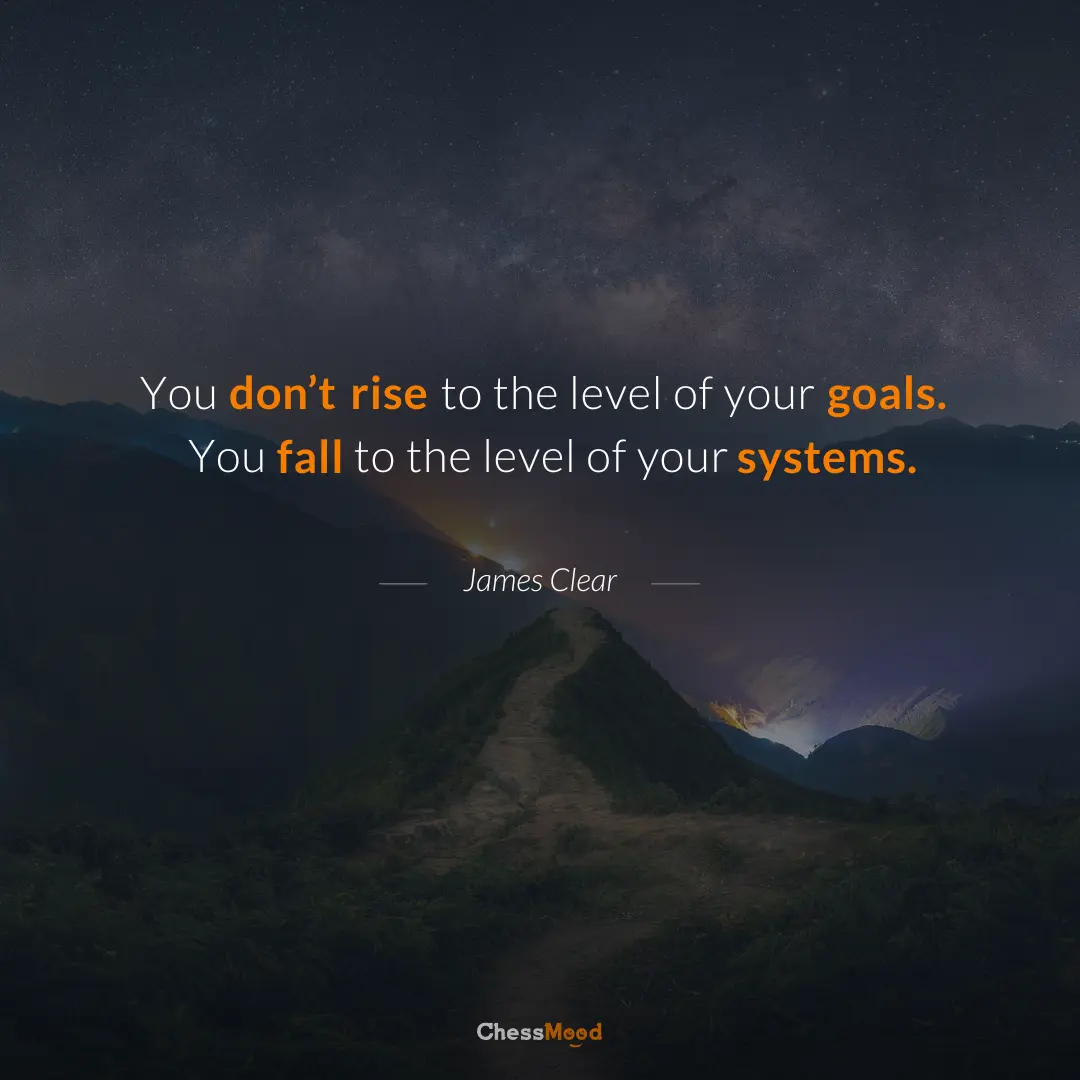
You focus on the process and the system.
So instead of saying
“I will raise 500 points”
You say
“I will finish this course.”
“Then I will finish that one.”
“I will play X games per week.”
“I will analyze my games every Sunday.”
Instead of saying
“I will lose 20 pounds”
You say
“I will go to the gym three times a week.”
“I will cut sugar.”
“I will allow one cheat day.”
Instead of saying
“I will make $100k this year”
You say
“I will contact 10 potential clients every week.”
“I will learn this skill.”
“I will build this side project.”
Now the brain is active and excited.
Because it sees something doable.
Something concrete.
Do Monks Really Set Goals?
Monks don’t chase outcomes.
They don’t say, “I must become enlightened by December.”
Their goals are internal and directional.
A monk might have goals like:
Live with less suffering.
Train the mind.
Reduce attachment.
Serve better today than yesterday.
Notice something.
None of these can be checked off.
They are orientations, not finish lines.
What they do have very clearly are vows and practices.
Daily meditation.
Study.
Silence.
Service.
Discipline.

Western thinking flips this.
We obsess over the finish line.
Then hope motivation magically shows up.
Monks do the opposite.
They commit to the practice first.
And let outcomes take care of themselves.
So yes! Monks do set goals.
But…
They hold them lightly.
Like a compass in the pocket.
Not a weight on the chest.
That’s the lesson I stole from monks and invite you to steal too.
With best wishes and love,
For your growth and fun journey,
GM Avetik (or Avo, as my friends call me) ♥️
P. S. What are your goals (compass) for 2026, in chess and in life?
And what’s the plan?
Please share in our forum.
P. P. S. I’m just a FedEx guy, delivering lessons from my teachers to you.
If this message spoke to you and you know someone who might love or need this… share the package. That’s how knowledge travels, one package at a time.
Thank you for reading, for growing, and for helping someone else along the way. 🙏